Everything Is a Problem to Be Solved
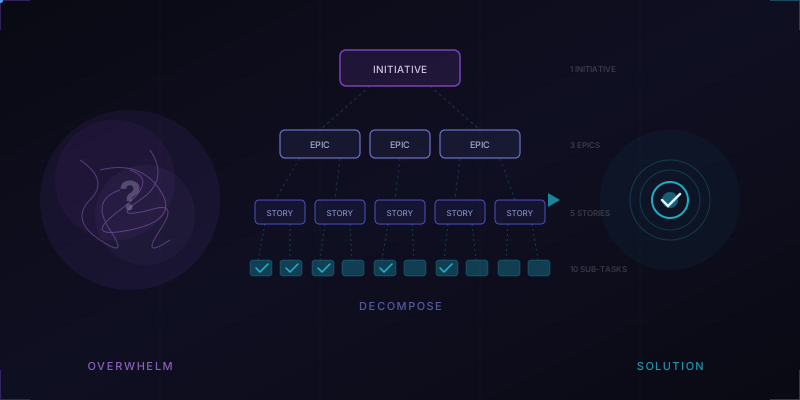
The Default Response
Something difficult happens and your brain does what it’s designed to do: it panics.
Fight or flight. Tunnel vision. Cortisol spike. The amygdala hijacks executive function and suddenly you’re not thinking -you’re reacting. The problem feels enormous, urgent, and unsolvable. All at once.
This is the default. It kept your ancestors alive when a predator appeared. But you’re not facing a predator. You’re facing a deadline, a difficult conversation, a life decision, a system that broke at 2 AM.
The panic response treats every problem like a threat to survival.
It almost never is.
The Shift
Here’s the reframe that changes everything:
Nothing is a crisis. Everything is a problem to be solved.
Not minimized. Not ignored. Not powered through with brute force. Solved. Methodically. Piece by piece.
A relationship conflict? That’s a problem with identifiable components. A career crossroads? That’s a decision tree with knowable branches. A system outage in production? That’s a bug with a root cause.
The moment you shift from “this is happening to me” to “this is something I can work through” -you reclaim your prefrontal cortex. The thinking brain comes back online. Options appear. The impossible starts looking like a sequence of possible steps.
This isn’t optimism. It’s methodology.
The Industry Already Solved This
Software engineering figured out problem-solving at scale decades ago. Not because developers are smarter -because they had no choice. The problems they face are so complex that without systematic decomposition, nothing would ever ship.
The entire point of tools like Jira -the industry standard for project management -is to enforce a single principle:
Break the overwhelming into the manageable.
Jira’s hierarchy makes this explicit:
| Level | What It Represents | Scale |
|---|---|---|
| Initiative | Large strategic goals spanning multiple teams and quarters | The vision |
| Epic | A significant body of work, often spanning multiple sprints | The chapter |
| Story / Task | A single unit of work, completable in one sprint | The scene |
| Sub-task | A smaller piece of work within a story | The sentence |
graph TD
    V["The Vision: Change Careers"]
    V --> C1["Chapter: Build New Skills"]
    V --> C2["Chapter: Build Credibility"]
    V --> C3["Chapter: Find Opportunities"]

    C1 --> S1["Scene: Take an online course"]
    C1 --> S2["Scene: Practice daily for 30 min"]

    C2 --> S3["Scene: Start a side project"]
    C2 --> S4["Scene: Write about what I learn"]

    S1 --> T1["Today: Watch lesson 1"]
    S1 --> T2["Today: Do the exercise"]
    S1 --> T3["Today: Take notes"]
An initiative like “Change careers” sounds impossible on Monday morning. But it’s not one problem. It’s a collection of chapters. Each chapter is a collection of scenes. Each scene is a collection of sentences. And a sentence? A sentence is something you can do today.
The transformation isn’t in the doing. It’s in the decomposition.
Nobody sits down and changes careers. They sit down and watch one lesson. Then do one exercise. Then write one paragraph. Then another. The new career emerges from the sequence.
The Story of the Problem
Breaking things down is the structure. But there’s a second skill that matters just as much:
How do you actually think through a problem?
Think of it as a story you’re writing.
Every problem -technical or personal -has a narrative. It has characters, context, cause, and consequence. It has a beginning (how did we get here?), a middle (what’s actually happening?), and an implied ending (what does resolution look like?).
When you face a complex problem, you’re looking at the general story. It’s dense. It’s overwhelming. The plot feels tangled.
So you do what any good reader does: you break the story into its elements.
What are the characters involved? What are their motivations? What events led to this moment? What are the constraints? What are the unknowns?
Then you go deeper. Each element has its own sub-elements. The “characters” in a system outage might be the load balancer, the database, the deployment pipeline, and the change that went out at 5 PM. Each of those has its own story -its own configuration, its own recent changes, its own failure modes.
You keep decomposing until the elements are small enough to understand.

And here’s the insight that most people miss:
Understanding Is the Solution
There’s an old engineering maxim:
“A problem well defined is a problem half solved.”
This isn’t a platitude. It’s literally how problem-solving works.
Most of the time, the reason a problem feels unsolvable is because you don’t understand it yet. You’re staring at the general story and trying to write the ending without reading the chapters.
When you break down a problem -when you decompose the story into its elements, and those elements into their elements -something happens. The fog lifts. The root cause becomes obvious. The solution presents itself, almost without effort.
You don’t solve most problems by being clever. You solve them by understanding them deeply enough that the answer becomes self-evident.
This is true everywhere:
| Domain | The Problem | What Understanding Reveals |
|---|---|---|
| Development | ”The app is slow” | One unindexed query running 400ms on every page load |
| Relationships | ”We keep fighting” | One unspoken expectation neither person has articulated |
| Career | ”I feel stuck” | One specific skill gap blocking the next transition |
| Health | ”I can’t sleep” | One habit (the phone in bed) disrupting the entire cycle |
The overwhelming always reduces to the specific. The vague always sharpens into the concrete. But only if you do the work of decomposition first.
The Method
Here’s the approach, distilled:
1. Stop reacting. Start observing.
The first step isn’t action. It’s pausing. Separate yourself from the emotional response and look at the situation like a system to be understood. What’s actually happening? Not what you feel about it. What’s happening?
2. Define the general story.
State the problem in one sentence. If you can’t, you don’t understand it yet. “The deployment pipeline is failing” is a starting point. “I’m unhappy at work” is a starting point. It doesn’t need to be precise -it needs to be stated.
3. Identify the elements.
What are the components of this problem? Who and what is involved? What are the inputs, outputs, and dependencies? Map them out. Write them down if you need to -externalize the complexity.
4. Decompose each element.
Take each component and ask: what is this made of? Keep going until you reach elements small enough to examine directly. This is where the Jira hierarchy applies -initiative to epic to story to sub-task.
5. Find the root.
Somewhere in your decomposition, you’ll find it -the actual source of the problem. It’s almost never where you first thought it was. It’s usually smaller, more specific, and more addressable than the general story suggested.
6. Solve the smallest thing first.
Don’t try to fix everything at once. Fix the root. Fix the smallest actionable piece. Then reassess. Often, solving one thing cascades into solving several.
Beyond Work
This isn’t a productivity hack. It’s a way of relating to difficulty itself.
When you train yourself to see problems as decomposable, something shifts in how you experience challenge. The panic response weakens -not because you suppress it, but because the thinking brain gets faster at intervening. The gap between “this is overwhelming” and “let me break this down” shrinks.
Fear of the unknown is really fear of the unexamined. When you develop the habit of examining -of pulling the story apart into its elements -the unknown becomes the not-yet-known. And the not-yet-known is just work to be done.
Every problem you’ve ever solved started as something you didn’t understand.
The misunderstanding was never permanent. It just required decomposition.
The Takeaway
Life doesn’t come with tickets and sprints. Nobody’s assigning you story points for navigating a difficult relationship or rebuilding your career.
But the method is the same.
Start with the big picture. Break it down. Understand the elements. Understand the elements of the elements. Keep going until the fog clears and the path becomes visible.
Panic is the default. Problem-solving is the override.
The override is a skill. Skills are built through practice. And every difficult thing you face -at work, at home, in your own head -is practice.
Everything is a problem to be solved. The question is whether you’ll react to it or decompose it.