Understanding Modern Web Architecture
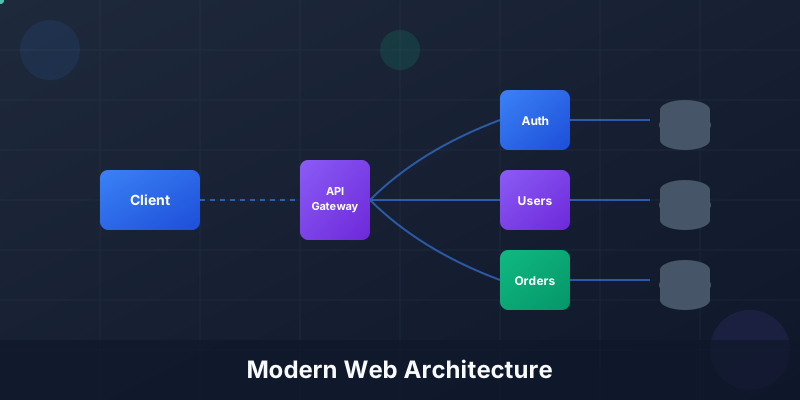
Modern web architecture has evolved dramatically over the past decade. What started as simple server-rendered pages has transformed into complex distributed systems serving millions of users globally. This guide breaks down the key architectural patterns, when to use them, and how they fit together.
The Architecture Spectrum
Web applications exist on a spectrum from simple to complex. Understanding where your application fits helps you make better architectural decisions.
graph LR
    A[Static Site] --> B[Monolith]
    B --> C[Modular Monolith]
    C --> D[Microservices]
    D --> E[Serverless]

    style A fill:#10b981,color:#fff
    style B fill:#3b82f6,color:#fff
    style C fill:#8b5cf6,color:#fff
    style D fill:#f59e0b,color:#fff
    style E fill:#ef4444,color:#fff
Each step adds complexity but also capabilities. The key is choosing the right level for your needs.
Monolithic Architecture
Most applications should start here. A monolith is a single deployable unit containing all your application logic.
graph TB
    subgraph Monolith["Monolithic Application"]
        UI[UI Layer]
        BL[Business Logic]
        DAL[Data Access Layer]
    end

    UI --> BL
    BL --> DAL
    DAL --> DB[(Database)]

    Client[Client Browser] --> UI
Advantages
| Benefit | Description |
|---|---|
| Simplicity | Single codebase, easy to understand |
| Development Speed | No network calls between services |
| Debugging | Stack traces show the full picture |
| Deployment | One artifact to deploy |
| Testing | Integration tests are straightforward |
When It Breaks Down
Monoliths struggle when:
- Teams grow beyond 10-15 developers
- Different components need different scaling
- Deployment frequency needs to increase
- Technology choices become limiting
The Modular Monolith
Before jumping to microservices, consider the modular monolith. It provides logical separation while maintaining deployment simplicity.
graph TB
    subgraph App["Modular Monolith"]
        subgraph Users["Users Module"]
            UA[API]
            US[Service]
            UR[Repository]
        end

        subgraph Orders["Orders Module"]
            OA[API]
            OS[Service]
            OR[Repository]
        end

        subgraph Products["Products Module"]
            PA[API]
            PS[Service]
            PR[Repository]
        end
    end

    UA --> US --> UR
    OA --> OS --> OR
    PA --> PS --> PR

    UR & OR & PR --> DB[(Shared Database)]
Module Boundaries
Each module should:
- Own its data - Other modules access data through the module’s API
- Have clear interfaces - Public APIs are explicit, internals are hidden
- Be independently testable - Modules can be tested in isolation
- Minimize coupling - Dependencies between modules should be intentional
Microservices Architecture
When you genuinely need independent deployment and scaling, microservices become valuable.
graph TB
    Client[Client] --> Gateway[API Gateway]

    Gateway --> Auth[Auth Service]
    Gateway --> Users[Users Service]
    Gateway --> Orders[Orders Service]
    Gateway --> Products[Products Service]

    Auth --> AuthDB[(Auth DB)]
    Users --> UsersDB[(Users DB)]
    Orders --> OrdersDB[(Orders DB)]
    Products --> ProductsDB[(Products DB)]

    Orders -.-> Users
    Orders -.-> Products

    subgraph Message Bus
        MQ[Message Queue]
    end

    Orders --> MQ
    Products --> MQ
    Users --> MQ
The Hidden Costs
Microservices introduce significant complexity:
| Challenge | Impact |
|---|---|
| Network Latency | Every service call adds milliseconds |
| Distributed Transactions | No simple rollbacks across services |
| Operational Overhead | More services = more things to monitor |
| Data Consistency | Eventual consistency becomes the norm |
| Testing Complexity | Integration tests require running multiple services |
When Microservices Make Sense
Consider microservices when you have:
- Multiple teams that need to deploy independently
- Different scaling requirements for different parts of the system
- Technology diversity needs (e.g., ML service in Python, API in Go)
- Strict fault isolation requirements
The Request Flow
Understanding how a request flows through your architecture is crucial for debugging and optimization.
sequenceDiagram
    participant C as Client
    participant CDN as CDN/Edge
    participant LB as Load Balancer
    participant API as API Server
    participant Cache as Redis Cache
    participant DB as Database

    C->>CDN: GET /api/products
    CDN->>LB: Cache miss
    LB->>API: Forward request
    API->>Cache: Check cache
    Cache-->>API: Cache miss
    API->>DB: Query products
    DB-->>API: Product data
    API->>Cache: Store in cache
    API-->>LB: JSON response
    LB-->>CDN: Response
    CDN-->>C: Cached response
Key Architectural Patterns
1. API Gateway Pattern
Centralizes cross-cutting concerns like authentication, rate limiting, and logging.
Client → API Gateway → Service A
                    → Service B
                    → Service C
2. Event-Driven Architecture
Services communicate through events rather than direct calls.
graph LR
    OrderService[Order Service] -->|OrderCreated| Queue[(Event Bus)]
    Queue -->|OrderCreated| Inventory[Inventory Service]
    Queue -->|OrderCreated| Email[Email Service]
    Queue -->|OrderCreated| Analytics[Analytics Service]
3. CQRS (Command Query Responsibility Segregation)
Separate read and write models for complex domains.
graph TB
    Client[Client]

    Client -->|Commands| WriteAPI[Write API]
    Client -->|Queries| ReadAPI[Read API]

    WriteAPI --> WriteDB[(Write DB)]
    WriteDB -->|Events| Sync[Sync Process]
    Sync --> ReadDB[(Read DB)]
    ReadAPI --> ReadDB
Performance Considerations
Architecture directly impacts performance. Here’s a decision framework:
graph TD
    Start[Performance Issue?] --> Type{Read or Write?}

    Type -->|Read Heavy| ReadOpt[Read Optimizations]
    Type -->|Write Heavy| WriteOpt[Write Optimizations]

    ReadOpt --> Cache[Add Caching Layer]
    ReadOpt --> Replica[Read Replicas]
    ReadOpt --> CDN[CDN for Static]

    WriteOpt --> Async[Async Processing]
    WriteOpt --> Queue[Message Queues]
    WriteOpt --> Shard[Database Sharding]
Caching Strategy
| Layer | Use Case | TTL |
|---|---|---|
| CDN | Static assets, public API responses | Hours to days |
| Application | Session data, computed results | Minutes to hours |
| Database | Query results | Seconds to minutes |
Security Architecture
Security must be built into your architecture, not bolted on afterward.
graph TB
    Internet[Internet] --> WAF[Web Application Firewall]
    WAF --> LB[Load Balancer]

    subgraph DMZ["DMZ"]
        LB --> API[API Gateway]
    end

    subgraph Private["Private Network"]
        API --> Auth[Auth Service]
        API --> App[Application Services]
        App --> DB[(Database)]
    end

    Auth --> IdP[Identity Provider]
Security Layers
- Network Level - Firewalls, VPCs, security groups
- Transport Level - TLS everywhere, certificate management
- Application Level - Authentication, authorization, input validation
- Data Level - Encryption at rest, access controls
Making the Decision
Use this decision tree to guide your architecture choice:
graph TD
    Start[New Project] --> Team{Team Size?}

    Team -->|1-5 devs| Mono[Start with Monolith]
    Team -->|5-15 devs| ModMono[Consider Modular Monolith]
    Team -->|15+ devs| Evaluate[Evaluate Microservices]

    Mono --> Growth{Growing Fast?}
    Growth -->|Yes| ModMono
    Growth -->|No| Mono

    ModMono --> Scale{Different Scaling Needs?}
    Scale -->|Yes| Evaluate
    Scale -->|No| ModMono

    Evaluate --> Ready{Team Ready?}
    Ready -->|Yes| Micro[Microservices]
    Ready -->|No| ModMono
Practical Recommendations
- Start simple - A well-structured monolith beats a poorly designed microservices architecture
- Invest in observability - Logging, metrics, and tracing are essential regardless of architecture
- Automate deployment - CI/CD pipelines make any architecture manageable
- Design for failure - Assume components will fail and plan accordingly
- Document decisions - Future you will thank present you
Conclusion
Modern web architecture is about making informed trade-offs. There’s no universal “best” architecture -only the right architecture for your specific context, team, and constraints.
Start with the simplest architecture that could work, measure its limitations, and evolve intentionally. The best architectures are grown, not designed upfront.
Remember: the goal is to ship value to users, not to build the most sophisticated system possible.